
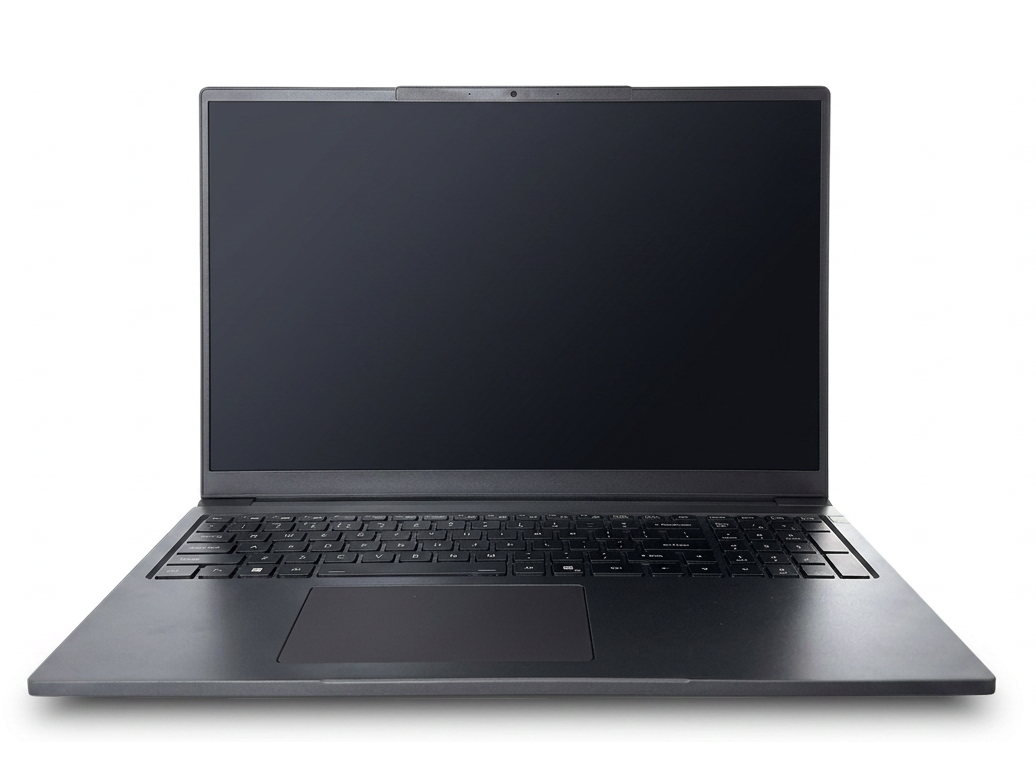
There’s a category of laptop user who doesn’t fit the productivity mold or the pure-gaming mold, because they’re both. They edit a photo set in the afternoon and play a few ray-traced hours at night. They cut video, model in 3D, and stream. What that user needs is two things a thin productivity machine can’t provide: a discrete GPU with modern encode and ray-tracing hardware, and a display good enough that the colors on screen are the colors that ship.
The Blitz Ultra RTX is built for exactly that overlap. It combines an NVIDIA RTX 5060 — or, configured up, an RTX 5070 — with an Intel Core Ultra 7 356H, and puts them behind a 15.3-inch OLED panel with DCI-P3 coverage and a 165Hz refresh rate. The OLED serves both halves of the job: the wide color gamut and per-pixel contrast that color-critical creative work demands, and the instant response and deep blacks that make games look their best.
A creator laptop is judged twice — once by the render clock, and once by whether the color you approved is the color everyone else sees. This one is built to pass both. // Eurocom Test Lab · Product Focus
// 01 As-Configured
The Blitz Ultra RTX is configured to order in Ottawa. The base build starts from approximately $1,525; unlike the integrated-graphics Blitz Ultra 180, its memory and storage are open configuration choices, so you scale both to your workload.
// 02 The GPU: RTX 5060 / 5070
The discrete GPU is the reason this machine exists, and it’s where the two configurations diverge. The base Blitz Ultra RTX carries an NVIDIA GeForce RTX 5060 with 8GB of GDDR7; stepping up to the RTX 5070 adds headroom for heavier creative projects and higher-detail gaming. Both are built on NVIDIA’s current Blackwell architecture, which matters for creators and gamers in three concrete ways.
First, ray tracing. Blackwell’s RT cores accelerate the lighting, reflection, and shadow math that modern game engines — and 3D renderers like Blender Cycles and V-Ray — use for photoreal output. Second, DLSS. NVIDIA’s AI upscaling and frame-generation technology, running on the GPU’s Tensor cores, lets the RTX 5060 push high frame rates at the panel’s native QHD+ resolution without dropping visual quality. Third — and this is what tips the machine toward creators — the on-board NVENC media engine hardware-accelerates H.264, HEVC, and AV1 encoding, which slashes video export times in editors like Premiere Pro and DaVinci Resolve and enables high-quality game streaming with almost no performance cost.
The 8GB of fast GDDR7 memory is the working space for all of it: game textures at native resolution, editorial timelines, and 3D scenes. For creators whose projects push past what 8GB comfortably holds — large 4K/8K timelines or heavy 3D scenes — the RTX 5070 option is the configuration to specify.
// 03 The Processor
Feeding a discrete GPU takes a capable CPU, and the Core Ultra 7 356H is matched to the job. Its hybrid design uses high-clocking performance cores for the single-threaded bursts that games and creative apps lean on, and efficient cores for the parallel, background work — media indexing, exports queued behind an active edit, and the general multitasking of a creator’s desktop.
For content workflows, the CPU and GPU split the load: the processor handles decode, timeline logic, and effects that aren’t GPU-bound, while the RTX GPU takes rendering, encode, and AI-accelerated tools. The integrated Intel Arc graphics and on-die NPU are useful too — the NPU accelerates the AI features now common in creative software and video calls, and integrated graphics can drive display output for lighter tasks, leaving the discrete GPU free.
// 04 The OLED Panel
For a creator, the display isn’t an output device — it’s the reference. The Blitz Ultra RTX uses a 15.3-inch OLED QHD+ 2560 × 1600 panel in the 16:10 aspect ratio, and OLED is the deliberate choice here. Because every pixel emits its own light, blacks are truly black, contrast is effectively infinite, and there’s no backlight glow washing out shadow detail — the qualities that make a grade or a photo edit trustworthy.
The DCI-P3 wide color gamut is what makes it a working creative panel. DCI-P3 is the color space of digital cinema and modern HDR content, and covering it means the saturated reds, greens, and blues in video and photography display accurately rather than clipped — so the color you approve is closer to the color your audience sees. The 165Hz refresh rate then does double duty: it keeps editorial scrubbing and UI motion fluid for creators, and delivers the fast, tear-free motion and OLED’s near-instant pixel response that make games look their best. Wide viewing angles keep color and brightness consistent across the panel and when others are watching over your shoulder.
// 05 Memory & Storage
Where the Blitz Ultra 180 fixes its memory on-board for efficiency, the Blitz Ultra RTX opens memory and storage as configuration choices — the right call for a creator/gaming machine, because those two workloads have the widest range of appetite. A gamer may be well served by a mainstream memory and a single fast NVMe; a video editor working in 4K wants more of both, with storage sized to hold projects and cache locally.
Because memory and storage are priced separately from the base, you build to your actual workload rather than paying for a fixed tier. Specify generous memory if you edit or run 3D applications alongside a browser full of references, and size the NVMe to keep active projects, game libraries, and scratch files on fast local storage.
// 06 Camera, Security & Wireless
The 5.0MP Windows Hello camera is a step above a basic webcam on two fronts: the higher-resolution sensor is genuinely useful for creators who appear on camera — streaming, calls, and recorded content — and its IR facial recognition enables Windows Hello, so you sign in by looking at the machine. Paired with the TPM hardware root of trust, that’s fast biometric sign-in backed by hardware-level credential protection and device encryption.
Wireless is current-generation Wi-Fi 7 via the Intel BE211 card, which matters more than it sounds for this audience: higher throughput for moving large media files to and from network storage, and lower-latency, more stable connections for online gaming and streaming on a busy network.
Every Eurocom laptop is configured to order in Ottawa. The Blitz Ultra RTX starts from approximately $1,525; choose your GPU (RTX 5060 or RTX 5070), memory, SSD capacity, operating system, warranty, and on-site service.
Open Configurator →// 07 Real Workflows
Photo & video editing
The DCI-P3 OLED panel gives Lightroom, Photoshop, Premiere Pro, and DaVinci Resolve a color-accurate reference, while the RTX GPU accelerates effects, playback, and — via NVENC — export. AV1 and HEVC hardware encode cut delivery times, and the RTX 5070 option adds headroom for heavier 4K work.
3D, design & motion
Blender, substance work, and CAD-adjacent design benefit from Blackwell’s ray-tracing cores and CUDA acceleration; the 8GB GDDR7 frame buffer holds moderate scenes, with the 5070 for larger ones. The 16:10 OLED keeps viewport and tool panels visible at once.
Gaming
At the panel’s native QHD+ resolution, the RTX 5060 with DLSS and ray tracing targets high frame rates with modern visual effects intact; the OLED’s deep blacks and near-instant response make it a genuinely great gaming screen. The 230W adapter supplies the power the GPU needs at full tilt.
Streaming & content
NVENC handles game and screen capture with minimal performance cost, the 5.0MP camera provides a clean on-camera image, and Wi-Fi 7 keeps uploads and live streams stable — a self-contained create-and-broadcast setup.
// 08 Verdict
The Blitz Ultra RTX is the machine for the person who refuses to choose between creating and playing. Its two defining components — a Blackwell RTX GPU with modern ray tracing, DLSS, and NVENC, and a 15.3-inch OLED panel with DCI-P3 color — serve both halves of that life directly. The GPU renders, encodes, and games; the OLED makes creative color trustworthy and games gorgeous. Around them, the Core Ultra 7 356H, Wi-Fi 7, a 5.0MP Windows Hello camera, and configurable memory and storage round out a genuinely capable compact workstation.
What you trade for the discrete GPU is the thin-and-light profile and all-day battery of an ultraportable — the 60Wh battery and 230W adapter are the honest cost of real graphics power. What you get, from about $1,525 plus the memory and storage you choose, is a configure-to-order creator and gaming laptop backed by Eurocom’s enterprise warranty and on-site service. If your work is documents and travel, the Blitz Ultra 180 is the lighter answer; if it’s pixels, frames, and color, this is the one.
- NVIDIA RTX 5060 with 8GB GDDR7 (RTX 5070 optional) — Blackwell ray tracing, DLSS, and NVENC hardware encode for creators and gamers
- 15.3" OLED QHD+ 2560 × 1600 · 16:10 · 165Hz · DCI-P3 — color-accurate creative reference and a deep-black, fast-response gaming screen
- Intel Core Ultra 7 356H with integrated Arc graphics and on-die NPU — matched CPU to feed the discrete GPU
- Configurable memory and storage — scale both to your workload rather than a fixed tier
- 5.0MP Windows Hello camera + TPM — biometric sign-in and hardware-backed security; clean image for streaming and calls
- Wi-Fi 7 (BE211), 60Wh battery, 230W adapter — current-gen wireless and the power a full-tilt GPU needs
- From approximately $1,525 plus memory and storage — configured to order in Ottawa